
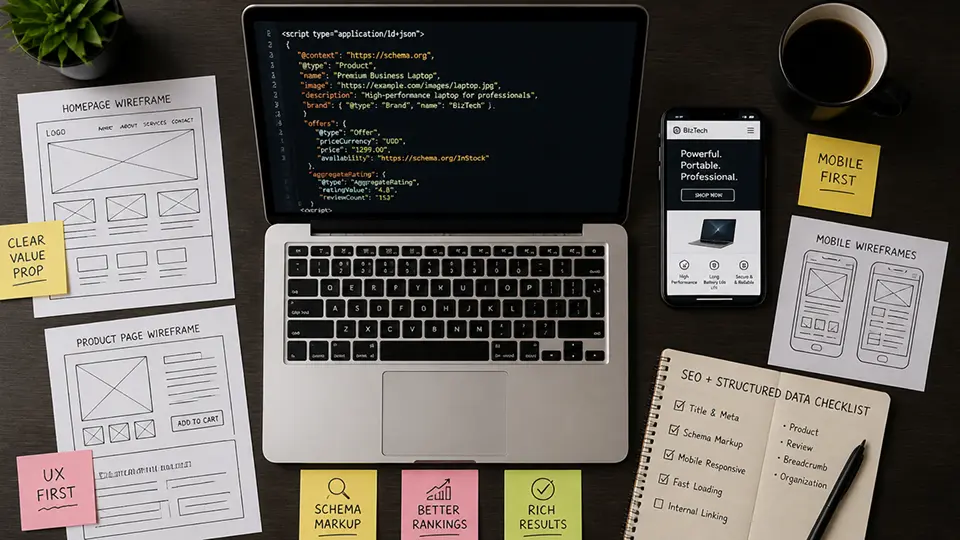
We built this on-page SEO checklist to help small business owners fix the things that actually move rankings in Google and AI search, without needing a marketing department or a stack of paid tools. If you run a local service business, a small ecommerce store, or a B2B company with a lean team, this is the order to work through your website.
Most checklists online throw 20 to 50 tasks at you with no sense of priority. That approach works for agencies auditing enterprise sites. It does not work if you’re the person who also answers the phones. So this guide focuses on the on-page elements with the biggest impact on visibility, in the order you should tackle them.
| No | Checklist Item | Impact on Rankings | Effort to Fix | Do This When |
| 1 | Title tag (keyword-led, under 60 characters) | High | Low | This week |
| 2 | Single, matching H1 | High | Low | This week |
| 3 | Meta description (specific, under 155 characters) | Medium | Low | This week |
| 4 | Answer-first content under each subheading | High | Medium | This week |
| 5 | One keyword and intent per page | High | Medium | Before writing new pages |
| 6 | Clean, descriptive URL slug | Medium | Low | At publish, or next redesign |
| 7 | Header structure (H1-H4 outline) | Medium | Medium | During content edits |
| 8 | Natural keyword placement and related terms | Medium | Low | During content edits |
| 9 | Internal links to related pages | Medium | Low | Ongoing |
| 10 | Image alt text and file names | Low-Medium | Low | Ongoing |
| 11 | Schema markup (Local Business, Article, FAQ) | Medium | High | Once content is solid |
| 12 | Mobile experience and page speed | High | High | Quarterly check |
Use this table as your working order. Items 1 through 4 are the ones most small business sites are missing entirely, and they’re also the fastest to fix, which makes them the obvious starting point regardless of how much time you have this month.
Below are the On-Page SEO checklist that can be followed by small businesses to get their online presence notable.
Before touching a single tag, decide what one keyword and one search intent this page is built to satisfy. A page trying to rank for “plumbing services,” “emergency plumber,” and “water heater repair” all at once usually ranks for none of them well.
Pick one primary keyword per page. Match it to how a real customer would search: are they researching, comparing, or ready to buy? A page written for someone comparing options should read differently than a page written for someone ready to call you. If your page mixes intents, split it into two pages instead.
Your title tag is the first thing both Google and AI search tools use to understand what your page covers. Two rules matter most here: keep your primary keyword near the start of the tag, and keep the whole thing under 60 characters so it doesn’t get cut off in search results.
Avoid generic titles like “Home” or “Services.” Instead, be specific: “Emergency Plumber in Sacramento | 24/7 Response” tells both search engines and searchers exactly what they’ll find.
Every page needs exactly one H1, and it should closely mirror your title tag while being a little more descriptive since it doesn’t face the same character limit. This heading is also what AI-powered search tools scan first to determine a page’s purpose, so don’t skip it or bury it in a hero image with no text equivalent.
The meta description doesn’t directly affect rankings, but it’s your pitch in the search results. Include your primary keyword naturally, state what the visitor gets, and keep it under roughly 155 characters so it doesn’t truncate. A specific, benefit-led description consistently outperforms a vague one on click-through rate, and click-through rate is one of the clearest signals you actually control.
Short, descriptive URLs help both users and crawlers understand a page at a glance. Use your primary keyword, separate words with hyphens, and cut anything unnecessary. A slug like /water-heater-repair-sacramento beats /services?id=204 or /page-1-water-heater-repair-sac-2026 every time. Skip dates in the slug itself since they make evergreen content look stale the moment the year changes.
This is the step most small business sites get wrong, and it’s become more important as AI tools like Google’s AI Overviews and ChatGPT search pull content directly into generated answers. The first sentence under any subheading should answer the question that heading raises, not build up to it with backstory.
If your H2 asks “How much does a water heater installation cost?”, the very next sentence should give a real number or range, not three paragraphs of general context before the answer shows up. Search systems and AI tools reward pages that make information easy to extract. Readers do too.
Use header tags (H1 through H4) to build a real outline, not just visual formatting. Each section should cover one subtopic and make sense if someone lands on it directly, since that’s increasingly how AI tools surface content: they pull a specific passage, not the whole page. Break up dense paragraphs, use bullet points where a list genuinely helps, and bold key terms sparingly so skimmers can navigate the page in seconds.
Place your primary keyword in the first paragraph, then use natural variations and related terms throughout the body. If you’re writing about “water heater repair,” related terms like “tank replacement,” “no hot water,” and “water heater lifespan” add context without forcing the same phrase over and over. Keyword stuffing reads poorly to humans and is easy for modern search algorithms to detect and penalize.
Every page should link to two to five other relevant pages on your site, using descriptive anchor text rather than “click here.” Internal links help visitors find related services, help search engines understand your site’s structure, and build what’s known as topical authority: the more your site demonstrates depth on a subject through connected pages, the more search engines and AI tools trust you as a source on that topic.
Images should have descriptive file names and alt text that explains what’s shown, not a generic placeholder. This helps with accessibility, gives search engines more context about your page, and creates a secondary path to traffic through image search. Compress images before uploading so they don’t slow down your page load time, since page speed is a confirmed ranking factor and a real driver of bounce rate.
Schema markup is structured code added to your page that tells search engines exactly what type of content they’re looking at: a local business, a product, a review, an FAQ. It’s one of the more technical items on this list, but it’s also one of the highest-leverage, since it can unlock rich results in Google and gives AI tools cleaner data to cite. Local Business schema, Article schema, and FAQ schema cover most small business needs.
Google evaluates your site primarily on its mobile version, and a slow or broken mobile experience undercuts every other item on this list. Run your page through a free speed testing tool, fix anything flagged as a major issue, and physically load your site on a phone to make sure buttons are tappable and text is readable without pinching to zoom.
On-page SEO is not a one-time project. Search engines update their systems constantly, and AI-driven search adds a new layer worth tracking: whether your content gets pulled into AI-generated answers at all. Revisit the priority table above every time you publish or update a page, and treat it as a standing part of how you build your site, not a task you finish once and forget.
If working through this list feels like more time than your business has to spare, that’s exactly the gap Anatech Consultancy fills for small and mid-size businesses: full on-page audits, content rewrites, and ongoing SEO management built around your actual growth goals, not a generic checklist. Get in touch to talk through where your site stands today.
Most small business sites see early movement within one to three months of consistent on-page fixes, with more substantial ranking gains building over three to six months. Timelines vary based on how competitive your keywords are and how much authority your site already has.
A business owner with time and patience can work through the fundamentals in this checklist without outside help. Where most owners run into trouble is prioritization and consistency: knowing what to fix first and keeping up with it across dozens of pages. That’s typically where bringing in outside help pays for itself.
Yes. AI-powered search tools like Google’s AI Overviews and ChatGPT search still rely on crawling and understanding web pages to generate their answers, and well-structured on-page content is what makes a page easy for those systems to extract and cite. The fundamentals in this checklist support both traditional rankings and AI search visibility at the same time.
On-page SEO covers the content and HTML elements on an individual page: title tags, headings, body content, images, and internal links. Technical SEO covers site-wide infrastructure: crawlability, site speed, mobile-friendliness, and indexing. Both are necessary, but on-page SEO is usually where a small business gets the most impact for the least effort.
We’re here to talk about your project, your challenges, and how we can solve them.

Founder & CEO