Ranking first on Google no longer guarantees a customer finds your business. A company can hold the top organic spot and still be completely invisible when someone asks ChatGPT the same question. That gap is why Anatech Consultancy helps businesses build the AI search visibility that earns recommendations from ChatGPT, Gemini, and Google AI Overviews, because search rankings and AI recommendation engines run on two entirely different systems of logic.
Key Takeaways
Gartner research projects that traditional search engine volume will fall by roughly 25 percent by 2026 as more queries move to AI chatbots and virtual assistants. A quarter of the search traffic businesses have relied on for years is already migrating somewhere new, and most websites haven’t adjusted for it.
Google ranks individual pages against a specific query. AI tools like ChatGPT and Gemini evaluate how strongly a brand name is already tied to its category or its city across everything they can read about it. That distinction is the entire reason AI search visibility has become its own discipline rather than a subset of traditional SEO.
Generative Engine Optimization (GEO) is the practice of structuring a business’s content, data, and reputation signals so generative AI systems can accurately understand, summarize, and recommend that business in a conversational answer. It sits alongside traditional SEO rather than replacing it, and it is the core service Anatech uses to close this visibility gap for clients.
AI recommendations are not generated from a ranked list. They come from reputation aggregation, the process by which AI models form a composite view of a business by pulling signals from reviews, mentions, and content across many independent sources rather than from a single web page. A business with a strong website but thin third-party presence often loses out here.
Two other concepts explain why some businesses get recommended and others get skipped entirely.
Entity clarity is how precisely and consistently a business defines who it serves, where it operates, and what problem it solves across every online source. The clearer this picture is, the easier it becomes for an AI model to confidently describe and recommend that business without hesitation.
Review depth matters just as much. Businesses with a solid volume of detailed, positive reviews tend to appear far more consistently in AI-generated local recommendations than businesses with only a handful of reviews. Earned mentions, independent coverage on review sites, in local press, and in industry roundups, carry far more weight with AI systems than anything published on a business’s own website.
This shift is no longer a prediction sitting years away. Gartner research projects that traditional search engine volume will fall by roughly 25 percent by 2026 as more queries move to AI chatbots and virtual assistants. A quarter of the search traffic businesses have relied on for years is already migrating somewhere new, and most websites have not adjusted for it.
Pew Research Center’s 2026 study on American AI adoption found that nearly half of U.S. adults now use an AI chatbot, up sharply from just a few years earlier, and a majority of adults now read AI-generated summaries directly inside their search results, a feature commonly called AI Overviews.
AI Overviews is Google’s AI-generated summary panel that appears above traditional search results, synthesizing information from multiple sources to answer a query directly inside the search page. That is a meaningful share of potential customers making decisions before they ever click through to a website.
Build genuine review depth. Encourage detailed reviews that mention specific outcomes, not just star ratings.
Keep business details identical everywhere. Name, location, and services should read the same on a website, a Google Business Profile, and every directory listing.
Write content that answers real customer questions directly, rather than content built purely around a keyword. Anatech’s content team builds pages around exactly these kinds of conversational queries as part of its SEO services.
Pursue earned coverage. Local press, industry roundups, and third-party mentions carry more weight with AI systems than anything self-published.
Strengthen structured data and technical SEO, since AI recommendations are still built on top of solid search fundamentals. This is the core of Anatech’s Generative Engine Optimization work.
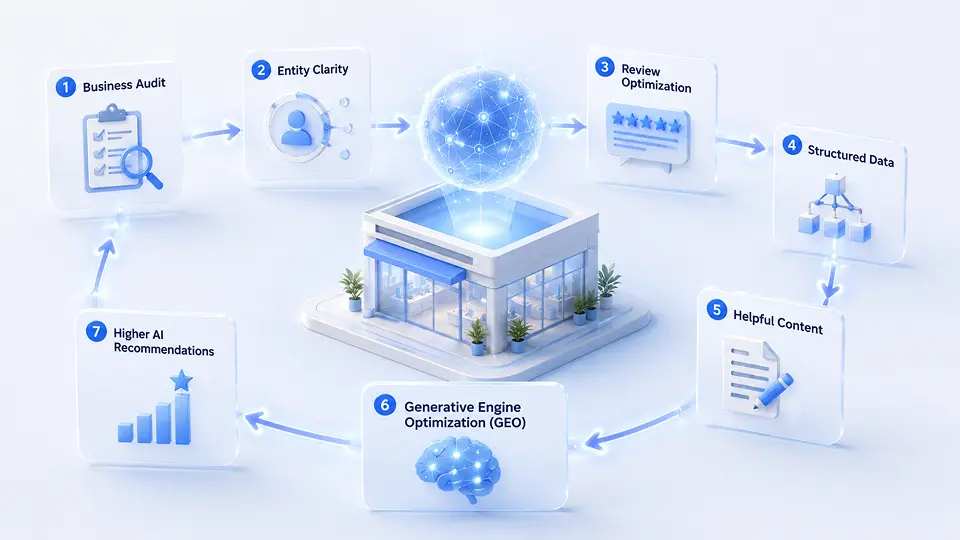
Anatech Consultancy treats AI search visibility as one connected system rather than a checklist. That means auditing entity clarity across a client’s web presence, closing review-depth gaps, tightening structured data, and building content around the conversational questions real customers ask AI tools. For clients running chatbots or automated customer touchpoints, this work also ties directly into Anatech’s AI automation and chatbot services, since the same entity and reputation signals that help a business get recommended by ChatGPT also improve how a client’s own AI tools represent that business to customers.
Google ranking measures how well one page answers a specific search query. ChatGPT recommendations measure how strongly a brand is already associated with a category or location across everything it can read about it.
There is no official published number, but businesses with a steady volume of detailed reviews appear far more consistently in AI recommendations than those with only a handful.
No. There is currently no advertising or paid placement system for organic AI recommendations. Visibility has to be earned through consistent, credible presence across reviews, content, and independent coverage.
Yes. AI recommendations are still built on top of solid search fundamentals, so a weak SEO foundation limits how well AI visibility efforts can perform.
A quarterly check is a reasonable habit, since AI models update, competitors strengthen their own presence, and business details can drift out of sync across platforms over time.
Anatech Consultancy audits entity clarity, closes review-depth gaps, strengthens structured data, and builds content around the real questions customers ask AI tools, combining GEO, AEO, and technical SEO into one strategy.
We’re here to talk about your project, your challenges, and how we can solve them.

Founder & CEO